"Enjoy when you can, and endure when you must." - Johann Wolfgang von Goethe
Europe is a mess. Italy has just been downgraded and Greece will default at any moment. The stock market, the only beneficiary of the Federal Reserve's quantitative easing, is struggling and the fear around the world has pushed gold to new highs. Every investment conference I go to touts gold and gold mining stocks. A bubble is starting to form in the space. Don't get me wrong it is still a long way from a bubble but it is coming. I would still load up on the gold mining stocks as the market has not yet priced in the gold price move but I doubt that this will be a long-term hold but rather a short-term trade.
The Federal Reserve is currently meeting. They have extended the meeting an extra day to make sure that everything that needs to be discussed is discussed. They have a lot to talk about and I believe that a lot of what will be said will be about another round of quantitative easing.
It is clear that the stock market needs the juice provided by the Federal Reserve to operate. Take the stimulus away and it is all over for the stock market. The housing market continues to drag and the shadow inventory will begin to show up in the very near future forcing prices even lower. The government entities are holding almost 1 million houses in inventory. They need to unwind these but there is no market for them. Add to this the number held by the banks and it is easy to see why the price of housing has nowhere to go but down.
With all of these issues and the problems in Europe, the Federal Reserve has no option but to continue to print money. They are already adding to the Eurodollar reserves. Even though I believe that the policy is flawed they are too deep into it to stop now. The questions are how large is the stimulus going to be and when will it happen? I believe that they will announce round three at the close of the meeting this week and that it will be a large amount. The reason for this is that this is really one of the last opportunities that they have without bringing into question their neutrality.
Already there is a lot of mud slinging going on in congress and President Obama has recently unveiled a tax hike aimed at the rich. Jobs and a balanced budget are front and center in the political debates and the Federal Reserve cannot be seen to support either side. Delaying the inevitable will create a situation that drags the Federal Reserve into the political spotlight. It cannot afford this if it is to remain intact. Already there is a high level of distrust of their policies and the politicians are eager to find somewhere to place the blame. What easier target than the Federal Reserve.
Therefore I believe that if we are to see some new easing it will be in the very near future and could easily be tomorrow. As such if you are a gambling man you could take a swing that it happens tomorrow and go long the market as if the announcement happens there should be a good upside pop. On the flip side I believe that the market is starting to price in another round of easing and if it does not happen you could be in for a huge decline. A safe way to play this is to buy options on the market. If you straddle the market with a put and a call option at the money then you could benefit no matter which direction the market goes. All you need is a big move and I believe that one is coming.
As this is a short-term trade I would not go all in on this but would limit your risk by moving the bulk of your investments into cash if you have not already done it. Look to alternate investments options and if you are at a loss as to what those may be contact me and I will point you in the right direction.
Tuesday, September 20, 2011


Monday, September 12, 2011
Investing versus Trading
"Business is the art of extracting money from another man's pocket without resorting to violence." - Max Amsterdam
This week's blog is very near and dear to my heart. When I began in this business over 20 years ago I was an investor through and through. The only way to invest was through hard work. Start with a detailed analysis of a company, drill down into the numbers to find hidden value, interview management to make sure that nothing was missed and if the stock was still cheap relative to the results from my analysis then I would load up on the position. If the stock dropped lower I would confidently add to my position and then wait patiently for the rest of the market to discover my hidden gem and take it to my target price. Once there I would offload.
Of course I would keenly await the quarterly reports and raise or lower my expectations based on management comments and the reported numbers and guidance. I would hold positions for months if not years and normally I would be rewarded for my effort. Time, effort and patience were virtues and a formal education in analysis was important. Do your apprenticeship with a financial consulting firm or one of the major investment banks and you had a ticket to riches.
This all changed with the NASDAQ bubble and the advent of massive computer power. I clearly remember during the NASDAQ bubble in 1999 a technical trader friend of mine asking which positions I held. After our discussion he took five minutes to evaluate each of these technically and purchased a few of the names on their "breakout". He proceeded to buy more and more as the stocks moved higher and then exited near the top for a massive profit. I was amazed that anyone could base millions of dollars on a technical chart.
Over the years since I have become a keen advocate of technical analysis mainly because the market has changed so much that it almost makes financial analysis worthless. Certainly there is a place for financial analysis but it is more and more likely to be found in private equity funds than in Wall Street hedge funds. Traders have taken over the market and seek to gain an edge not by superior financial analysis but through superior speed and cheaper price of execution of a trade.
Traders seeking an edge try to sit right next to the market (literally) to get a millisecond advantage over the competition that is sitting a thousand miles away. This is all that they need. Company stocks are unknown only tickers are relevant and price to earnings ratios are replaced with stock price momentum. This is why you have situations where high priced stocks just keep on going while lower priced stocks do not move.
This is all very good and well but it has turned Wall Street into a glorified casino. The authorities are turning a blind eye to all of this as they are all making money. The average daily volume of stocks traded has almost quadrupled over the past decade while the market value of the Standard and Poors 500 (the largest 500 companies listed on the United States stock markets) has not moved. Money is being made by charging a fee for each share traded. Meanwhile investors are not being rewarded for this greed and are in reality the chicken fodder. Give us your money so we can pay ourselves fees and you can receive a negative return on your money.
This has to stop and is going to end badly. While everyone is making money no-one will turn their attention to these market practices. The downside is that just as the computers are pushing prices higher, at some point when the market bursts they will drive prices lower and in a hurry. At this point Congress will look into the problem but by then it will be too late. Thousands of investors will have lost their shirts but this time hopefully Wall Street will be made to pay.
Protect yourself by moving out of the market and looking for opportunities elsewhere. For those of you with a conservative edge I would advise that you take a long hard look at your overall portfolio and try to find a decent yield in a low yield environment. As I mentioned to a friend of mine the other day, it is better to get out now and protect against a 50% retracement than to try to catch a 10% increase in the market. Things are skewed to the downside so look to exit and wait patiently for the bottom. It will come and you will be rewarded, just like the old days.
This week's blog is very near and dear to my heart. When I began in this business over 20 years ago I was an investor through and through. The only way to invest was through hard work. Start with a detailed analysis of a company, drill down into the numbers to find hidden value, interview management to make sure that nothing was missed and if the stock was still cheap relative to the results from my analysis then I would load up on the position. If the stock dropped lower I would confidently add to my position and then wait patiently for the rest of the market to discover my hidden gem and take it to my target price. Once there I would offload.
Of course I would keenly await the quarterly reports and raise or lower my expectations based on management comments and the reported numbers and guidance. I would hold positions for months if not years and normally I would be rewarded for my effort. Time, effort and patience were virtues and a formal education in analysis was important. Do your apprenticeship with a financial consulting firm or one of the major investment banks and you had a ticket to riches.
This all changed with the NASDAQ bubble and the advent of massive computer power. I clearly remember during the NASDAQ bubble in 1999 a technical trader friend of mine asking which positions I held. After our discussion he took five minutes to evaluate each of these technically and purchased a few of the names on their "breakout". He proceeded to buy more and more as the stocks moved higher and then exited near the top for a massive profit. I was amazed that anyone could base millions of dollars on a technical chart.
Over the years since I have become a keen advocate of technical analysis mainly because the market has changed so much that it almost makes financial analysis worthless. Certainly there is a place for financial analysis but it is more and more likely to be found in private equity funds than in Wall Street hedge funds. Traders have taken over the market and seek to gain an edge not by superior financial analysis but through superior speed and cheaper price of execution of a trade.
Traders seeking an edge try to sit right next to the market (literally) to get a millisecond advantage over the competition that is sitting a thousand miles away. This is all that they need. Company stocks are unknown only tickers are relevant and price to earnings ratios are replaced with stock price momentum. This is why you have situations where high priced stocks just keep on going while lower priced stocks do not move.
This is all very good and well but it has turned Wall Street into a glorified casino. The authorities are turning a blind eye to all of this as they are all making money. The average daily volume of stocks traded has almost quadrupled over the past decade while the market value of the Standard and Poors 500 (the largest 500 companies listed on the United States stock markets) has not moved. Money is being made by charging a fee for each share traded. Meanwhile investors are not being rewarded for this greed and are in reality the chicken fodder. Give us your money so we can pay ourselves fees and you can receive a negative return on your money.
This has to stop and is going to end badly. While everyone is making money no-one will turn their attention to these market practices. The downside is that just as the computers are pushing prices higher, at some point when the market bursts they will drive prices lower and in a hurry. At this point Congress will look into the problem but by then it will be too late. Thousands of investors will have lost their shirts but this time hopefully Wall Street will be made to pay.
Protect yourself by moving out of the market and looking for opportunities elsewhere. For those of you with a conservative edge I would advise that you take a long hard look at your overall portfolio and try to find a decent yield in a low yield environment. As I mentioned to a friend of mine the other day, it is better to get out now and protect against a 50% retracement than to try to catch a 10% increase in the market. Things are skewed to the downside so look to exit and wait patiently for the bottom. It will come and you will be rewarded, just like the old days.
Thursday, September 1, 2011
Labor Day 2011
"Borrowed money shortens time." - Chinese proverb
Labor Day in the United States is September 4th this year. According to the knowledgeable people at Wikipedia "it became a federal holiday in 1894, when, following the deaths of a number of workers at the hands of the US military and US Marshalls during the Pullman Strike, President Grover Cleveland put reconciliation with the labor movement as a top political priority. Fearing further conflict, legislation making Labor Day a national holiday was rushed through Congress unanimously and signed into law a mere six days after the end of the strike."
To celebrate labor's day it would seem that labor should again strike, walk on the government and demand that Congress implement policies that create jobs for the needy rather than the fat cats in bank high rises. Unemployment is terribly weak after years of stimulus and this week second quarter productivity was revised down by the largest drop since the fourth quarter of 2008. For those of you with short-term memories, the fourth quarter of 2008 was the eye of the storm in terms of market weakness. Non-farm productivity was revised down to -0.7%. Yes that is correct it is negative! This has to lead to further layoffs in the near future. Not a great way to celebrate labor's day.
To add to the hurricanes battering the East coast it appears that the economy continues to be battered and the Federal Reserve has all but given up its fight. Mr. Bernanke finally admitted that the severity of the market ills is far worse than he ever anticipated and handed over the reigns to Congress when he stated that ".. most of the economic policies that support robust economic growth in the long run are outside the province of the central bank." So let me get this straight; he spent trillions of dollars with no reward other than an overpriced stock market and now he walks away and says it is all Congresses fault? Don't get me wrong, I agree with him to a large degree, but what about mopping up the mess that he created with all the additional debt that we are now burdened with? That is the problem with this country at present, there is no leader willing to take up the helm and drive the ship into the storm. We can only run on this course for so long until either the storm catches us or we crash into rocks.
Let's turn to the Congressional Budget Office (CBO). The CBO is entrusted with estimating the growth of the economy and thereby expected tax revenues, surpluses, deficits and the like. Based on their expectations Congress makes its plans for the future of the country. Well the CBO expects that growth will be at 2.3% for the year. Considering that this number has already been ratcheted down a number of times and considering that we only grew at 1.4% for the first half of the year, there is absolutely no way that they are remotely close to being correct in their forecast. Furthermore they predict a 2.7% growth rate for 2012. It is my contention that 2012 will be the beginning of a recession and that the budget deficit will balloon just at the time when we need it to contract.
With Mr. Bernanke handing the reins over to Congress to make the right decisions (become austere) and with Congress relying on the inflated numbers from the CBO it looks like the hurricane will catch up to us before we reach the rocks! The Chinese who have lent us a significant amount of money have summed it up in the proverb at the beginning of this blog: "Borrowed money shortens time." I have said it before and I will say it again, get out of the market while it has sent you a life raft in the form of a weak bounce and harbor your cash into something safe for an extended period. Do not get sucked back into the market for at least the next 12 months.
To end this blog I am attaching a link that was provided to me by a friend. it is very clever and funny, particularly if you have spent any time in the mid-west like I did many years ago. Enjoy.
Labor Day in the United States is September 4th this year. According to the knowledgeable people at Wikipedia "it became a federal holiday in 1894, when, following the deaths of a number of workers at the hands of the US military and US Marshalls during the Pullman Strike, President Grover Cleveland put reconciliation with the labor movement as a top political priority. Fearing further conflict, legislation making Labor Day a national holiday was rushed through Congress unanimously and signed into law a mere six days after the end of the strike."
To celebrate labor's day it would seem that labor should again strike, walk on the government and demand that Congress implement policies that create jobs for the needy rather than the fat cats in bank high rises. Unemployment is terribly weak after years of stimulus and this week second quarter productivity was revised down by the largest drop since the fourth quarter of 2008. For those of you with short-term memories, the fourth quarter of 2008 was the eye of the storm in terms of market weakness. Non-farm productivity was revised down to -0.7%. Yes that is correct it is negative! This has to lead to further layoffs in the near future. Not a great way to celebrate labor's day.
To add to the hurricanes battering the East coast it appears that the economy continues to be battered and the Federal Reserve has all but given up its fight. Mr. Bernanke finally admitted that the severity of the market ills is far worse than he ever anticipated and handed over the reigns to Congress when he stated that ".. most of the economic policies that support robust economic growth in the long run are outside the province of the central bank." So let me get this straight; he spent trillions of dollars with no reward other than an overpriced stock market and now he walks away and says it is all Congresses fault? Don't get me wrong, I agree with him to a large degree, but what about mopping up the mess that he created with all the additional debt that we are now burdened with? That is the problem with this country at present, there is no leader willing to take up the helm and drive the ship into the storm. We can only run on this course for so long until either the storm catches us or we crash into rocks.
Let's turn to the Congressional Budget Office (CBO). The CBO is entrusted with estimating the growth of the economy and thereby expected tax revenues, surpluses, deficits and the like. Based on their expectations Congress makes its plans for the future of the country. Well the CBO expects that growth will be at 2.3% for the year. Considering that this number has already been ratcheted down a number of times and considering that we only grew at 1.4% for the first half of the year, there is absolutely no way that they are remotely close to being correct in their forecast. Furthermore they predict a 2.7% growth rate for 2012. It is my contention that 2012 will be the beginning of a recession and that the budget deficit will balloon just at the time when we need it to contract.
With Mr. Bernanke handing the reins over to Congress to make the right decisions (become austere) and with Congress relying on the inflated numbers from the CBO it looks like the hurricane will catch up to us before we reach the rocks! The Chinese who have lent us a significant amount of money have summed it up in the proverb at the beginning of this blog: "Borrowed money shortens time." I have said it before and I will say it again, get out of the market while it has sent you a life raft in the form of a weak bounce and harbor your cash into something safe for an extended period. Do not get sucked back into the market for at least the next 12 months.
To end this blog I am attaching a link that was provided to me by a friend. it is very clever and funny, particularly if you have spent any time in the mid-west like I did many years ago. Enjoy.
Wednesday, August 24, 2011
Recession Deux
"Prediction is very difficult, especially about the future." - Niels Bohr
It seems relatively clear to me that we are now entering another recession. I have named it Recession Deux as I believe it to be a double dip recession rather than a new recession altogether. We never truly recovered from the recession of 2008 and all indicators are pointing to us falling into part two of the Great Recession as some people have named it.
A recession does not normally end without some form of stability or growth in the housing market. Most of the population in the United States relies on housing as their main investment and retirement fund. In fact according to the federal government 50 percent of typical home-owning family wealth is tied to their real estate investments. As a market housing was valued at over $18 trillion as of the first quarter of 2011. However this does not tell the whole story. Housing as an industry accounts for about 27 percent of investment spending and 5 percent of overall economic activity in the United States annually.
Looking at housing data points to continued economic weakness. New home sales decreased for the third consecutive month. Furthermore existing home sales fell to 4.67 million homes in July. This is the second straight month of sales declines and the National Association of Realtors blamed the number of contracts that were cancelled as the source of the weakness. Sales cancellations point to a couple of areas of weakness: it is still difficult to find a lender willing to lend against housing; appraisals are coming in lower than the negotiated price of the house sale creating an additional problem with financing; and, with housing prices continuing to fall buyers are reconsidering buying. Until the inventory of distressed housing is cleared continued economic weakness will ensue. Considering that the lack of sales has pushed inventory levels to 9.4 months of supply the highest point since November 2010, it is unlikely that there is any economic recovery in the works.
In fact when you consider that the Federal Reserve has pushed over $3 trillion of stimulus into the economy and there is little to show for their actions it is easy to see why the weak recovery is turning to Recession Deux.
It seems relatively clear to me that we are now entering another recession. I have named it Recession Deux as I believe it to be a double dip recession rather than a new recession altogether. We never truly recovered from the recession of 2008 and all indicators are pointing to us falling into part two of the Great Recession as some people have named it.
A recession does not normally end without some form of stability or growth in the housing market. Most of the population in the United States relies on housing as their main investment and retirement fund. In fact according to the federal government 50 percent of typical home-owning family wealth is tied to their real estate investments. As a market housing was valued at over $18 trillion as of the first quarter of 2011. However this does not tell the whole story. Housing as an industry accounts for about 27 percent of investment spending and 5 percent of overall economic activity in the United States annually.
Looking at housing data points to continued economic weakness. New home sales decreased for the third consecutive month. Furthermore existing home sales fell to 4.67 million homes in July. This is the second straight month of sales declines and the National Association of Realtors blamed the number of contracts that were cancelled as the source of the weakness. Sales cancellations point to a couple of areas of weakness: it is still difficult to find a lender willing to lend against housing; appraisals are coming in lower than the negotiated price of the house sale creating an additional problem with financing; and, with housing prices continuing to fall buyers are reconsidering buying. Until the inventory of distressed housing is cleared continued economic weakness will ensue. Considering that the lack of sales has pushed inventory levels to 9.4 months of supply the highest point since November 2010, it is unlikely that there is any economic recovery in the works.
In fact when you consider that the Federal Reserve has pushed over $3 trillion of stimulus into the economy and there is little to show for their actions it is easy to see why the weak recovery is turning to Recession Deux.
Tuesday, August 16, 2011
A Loss of Confidence
"What we anticipate seldom occurs; what we least expect generally happens." - Benjamin Disraeli
Economists are at a loss as to what causes a loss of confidence. One minute everyone is happy with the status quo and the next people turn tail and run for the hills. This is of particular concern given the precipice on which the global economy is balanced. Confidence is fickle and right now it hangs in the balance. This is of great concern when governments and companies need to roll over large amounts of short-term debt which is precisely what is required at present. As an example of the size of short-term debt that needs to be rolled over, the recent stress tests performed on 90 European banks showed that EU 5.4 trillion of debt needs to be rolled in the next 24 months.
While the number is huge, in good economic times this would not be a problem. The issue is that unless there is the confidence that this amount will be repaid the market for these securities disappears. To attract buyers for this debt there needs to be the confidence that the debt will be repaid in a timely manner otherwise the interest rate needs to reflect the risk associated with non-repayment. A lack of confidence therefore leads to a spike in the interest rate right at the time when companies and governments can ill afford it. If confidence collapses, lenders disappear and a crisis ensues.
So what makes up confidence? Well unless you are an accountant you base your outlook on the current business environment and your expectation of future events. People typically follow the consensus of opinion (that is why it is the consensus) so when things are good, everyone seems to expect the goods times to continue to roll (this is why economies overheat and bubbles are created). The same is true when things turn bad; people generally take a bleak look at the future (this is why it is so hard to turn an economy around during a downturn). The issue is how to determine the inflection point, the point at which people or businesses decide that enough is enough.
Certainly at present there is an air of despair. In poor economic times people rely on their leaders to step up to the plate. Governments and central bankers are paid to take steam out of the economy when it is overheated and apply the accelerator during economic hard times. A look over the last millennium shows that there have been some success, but overall the timing of the government intervention, the amount of the intervention and the direction of that intervention is questionable. Looking back just a decade brings into question why so much support was given to the technology front by Mr. Greenspan and then why so much attention was placed on supporting the stock market collapse. This support in turn lead to the housing bubble and on and on it goes. Certainly it is very questionable as to the effectiveness of our leaders ability to support and control economic activity and it is doubtful that the current policies will be effective in solving the problems that we now face.
That aside the issue right now is one of a deteriorating level of confidence in our current administration and the governments of most of the first world economies. Given that the population of the globe is reliant on them to return the global economy to a more normal state it is very concerning to see their floundering in the eye of the storm. To the average man on the street the lack of quantifiable benefits from all of the trillions of dollars spent around the globe is feeding into their outlook. Unfortunately it is up to the politicians to correct this and looking at the lack of leaders prepared to do anything of substance (which may jeopardize their political careers) is sickening.
The downgrade of America's sovereign debt in and of itself is of little consequence, but it could be the tipping point that pushes the first domino leading to another major crisis. Only time will tell, but the lack of consumer and business confidence around the world comes at a very inopportune time and points at best towards another recession in the making and at worst a global crisis that few have ever witnessed.
Economists are at a loss as to what causes a loss of confidence. One minute everyone is happy with the status quo and the next people turn tail and run for the hills. This is of particular concern given the precipice on which the global economy is balanced. Confidence is fickle and right now it hangs in the balance. This is of great concern when governments and companies need to roll over large amounts of short-term debt which is precisely what is required at present. As an example of the size of short-term debt that needs to be rolled over, the recent stress tests performed on 90 European banks showed that EU 5.4 trillion of debt needs to be rolled in the next 24 months.
While the number is huge, in good economic times this would not be a problem. The issue is that unless there is the confidence that this amount will be repaid the market for these securities disappears. To attract buyers for this debt there needs to be the confidence that the debt will be repaid in a timely manner otherwise the interest rate needs to reflect the risk associated with non-repayment. A lack of confidence therefore leads to a spike in the interest rate right at the time when companies and governments can ill afford it. If confidence collapses, lenders disappear and a crisis ensues.
So what makes up confidence? Well unless you are an accountant you base your outlook on the current business environment and your expectation of future events. People typically follow the consensus of opinion (that is why it is the consensus) so when things are good, everyone seems to expect the goods times to continue to roll (this is why economies overheat and bubbles are created). The same is true when things turn bad; people generally take a bleak look at the future (this is why it is so hard to turn an economy around during a downturn). The issue is how to determine the inflection point, the point at which people or businesses decide that enough is enough.
Certainly at present there is an air of despair. In poor economic times people rely on their leaders to step up to the plate. Governments and central bankers are paid to take steam out of the economy when it is overheated and apply the accelerator during economic hard times. A look over the last millennium shows that there have been some success, but overall the timing of the government intervention, the amount of the intervention and the direction of that intervention is questionable. Looking back just a decade brings into question why so much support was given to the technology front by Mr. Greenspan and then why so much attention was placed on supporting the stock market collapse. This support in turn lead to the housing bubble and on and on it goes. Certainly it is very questionable as to the effectiveness of our leaders ability to support and control economic activity and it is doubtful that the current policies will be effective in solving the problems that we now face.
That aside the issue right now is one of a deteriorating level of confidence in our current administration and the governments of most of the first world economies. Given that the population of the globe is reliant on them to return the global economy to a more normal state it is very concerning to see their floundering in the eye of the storm. To the average man on the street the lack of quantifiable benefits from all of the trillions of dollars spent around the globe is feeding into their outlook. Unfortunately it is up to the politicians to correct this and looking at the lack of leaders prepared to do anything of substance (which may jeopardize their political careers) is sickening.
The downgrade of America's sovereign debt in and of itself is of little consequence, but it could be the tipping point that pushes the first domino leading to another major crisis. Only time will tell, but the lack of consumer and business confidence around the world comes at a very inopportune time and points at best towards another recession in the making and at worst a global crisis that few have ever witnessed.
Monday, August 8, 2011
Buy the Dip?
"Wise men don't need advice. Fools won't take it." - Benjamin Franklin
After this last week and particularly after today there have been a number of people commenting that you should buy this "pullback". The reasons I have heard range from the educated traders who know that in the next few days that there should be a bounce as the market is really oversold and always bounces at some point; to the completely naive who have been trained by the pigs of Wall Street to believe that stocks are always a good place to be and that a "pullback" such as this offers a great buying opportunity. "After all (as one person I spoke to this weekend said) the United States is such a great nation that everyone has to invest in the United States stock markets." How ignorant can you be?
My view is that you should remain well away from the market. Sure there may be another attempt by the Federal Reserve to bolster stocks and sure with the White House up for grabs next year there will be a lot of time and effort spent trying to make something rally, the reality is that the global economy stinks and is continuing to rot from the inside out. Until this rotting is reversed and the corpse called the global economy can be brought back to life there is no reason to try to time the market for a short-term bounce.
The S&P downgrade of the United States credit rating is just the tip of the iceberg. Look at the remaining countries with AAA credit rating and you will see that they all could very easily be stripped of that rating in very short order. France and Germany have the burden of the rest of the Euro zone on their shoulders, the United Kingdom is struggling to contain its debt loads, Australia and New Zealand will be hit hard by the slowdown in China, Canada is linked by the hip to the United States and to be honest all of the remaining 10 nations are too small to make any difference to the global economy. A contagion of downgrades will lead to another round of stock market pullbacks. As debt becomes harder and more expensive to find earnings and growth around the world will suffer and the market will tank. It is not a hard equation to work out, but for some reason people still think that they should own stocks.
Cash is an investment, and while cash may not earn you anything at present it is better to hold onto what you have than to give away 20 percent or more of your portfolio specifically if the upside is only 10 percent and is marred with risk. If you are still adamant to be in the market as it is for the "long haul" then look to high yielding solid dividend plays, but to be honest the "long haul" may just be too long for most to bear.
A look at the Japanese market will give you an understanding that the market does not have to recover any time soon. The Nikkei index reached around 40,000 in December 1989. Subsequent to that it fell, bounced, fell, bounced and now 22 years later it is still below 10,000. Yes that is not a mistake, it is still down 75% from its high. Could the United States markets be in the throws of such a secular bear market? I believe that this is the case. Will there be bounces in the market? Yes but unless you are very nimble and trade the markets daily you will find better value in other asset classes. Even if I am wrong and somehow the economy changes and we go back to a solid economic footing, there will still be plenty of time to buy stocks and make money in the market during the next bull market. The problem is that bull market appears to be a long way off.
After this last week and particularly after today there have been a number of people commenting that you should buy this "pullback". The reasons I have heard range from the educated traders who know that in the next few days that there should be a bounce as the market is really oversold and always bounces at some point; to the completely naive who have been trained by the pigs of Wall Street to believe that stocks are always a good place to be and that a "pullback" such as this offers a great buying opportunity. "After all (as one person I spoke to this weekend said) the United States is such a great nation that everyone has to invest in the United States stock markets." How ignorant can you be?
My view is that you should remain well away from the market. Sure there may be another attempt by the Federal Reserve to bolster stocks and sure with the White House up for grabs next year there will be a lot of time and effort spent trying to make something rally, the reality is that the global economy stinks and is continuing to rot from the inside out. Until this rotting is reversed and the corpse called the global economy can be brought back to life there is no reason to try to time the market for a short-term bounce.
The S&P downgrade of the United States credit rating is just the tip of the iceberg. Look at the remaining countries with AAA credit rating and you will see that they all could very easily be stripped of that rating in very short order. France and Germany have the burden of the rest of the Euro zone on their shoulders, the United Kingdom is struggling to contain its debt loads, Australia and New Zealand will be hit hard by the slowdown in China, Canada is linked by the hip to the United States and to be honest all of the remaining 10 nations are too small to make any difference to the global economy. A contagion of downgrades will lead to another round of stock market pullbacks. As debt becomes harder and more expensive to find earnings and growth around the world will suffer and the market will tank. It is not a hard equation to work out, but for some reason people still think that they should own stocks.
Cash is an investment, and while cash may not earn you anything at present it is better to hold onto what you have than to give away 20 percent or more of your portfolio specifically if the upside is only 10 percent and is marred with risk. If you are still adamant to be in the market as it is for the "long haul" then look to high yielding solid dividend plays, but to be honest the "long haul" may just be too long for most to bear.
A look at the Japanese market will give you an understanding that the market does not have to recover any time soon. The Nikkei index reached around 40,000 in December 1989. Subsequent to that it fell, bounced, fell, bounced and now 22 years later it is still below 10,000. Yes that is not a mistake, it is still down 75% from its high. Could the United States markets be in the throws of such a secular bear market? I believe that this is the case. Will there be bounces in the market? Yes but unless you are very nimble and trade the markets daily you will find better value in other asset classes. Even if I am wrong and somehow the economy changes and we go back to a solid economic footing, there will still be plenty of time to buy stocks and make money in the market during the next bull market. The problem is that bull market appears to be a long way off.
Thursday, August 4, 2011
Images of Debt
"Calamity n. A more than commonly plain and unmistakable reminder that the affairs of this life are not of our own ordering." - Ambrose Bierce
Now I normally do not use other people's work or images to make my point but these are so powerful that I thought you would enjoy seeing them. Below each is a brief commentary. The point of the matter is that until this mountain of debt starts to shrink there is trouble ahead. Combine this with the massive load of sovereign debt in Europe and other parts of the world and you can understand why the chances of a global soft landing are minimal. Remember that these debt levels continue to rise each and every day. You can learn more about how and why this happened by reading Ellen Brown's "THE WEB OF DEBT".
One Hundred Dollars - $100
 The most counterfeited money denomination in the world. Keeps the world moving.
Ten Thousand Dollars - $10,000


One Hundred Million Dollars - $100,000,000
 Plenty to go around for everyone. Fits nicely on a standard sized pallet.


If you spent $1 million a day since Jesus was born, you would have not spent $1 trillion by now...but ~$700 billion - same amount the banks got during bailout.
 Comparison of $1,000,000,000,000 dollars to a standard-sized American Football field and European Football field. Say hello to the Boeing 747-400 transcontinental airliner that's hiding on the right. This was until recently the biggest passenger plane in the world.
15 Trillion Dollars - 15,000,000,000,000
 Unless the U.S. government fixes the budget, US national debt (credit bill) will top 15 trillion by Christmas 2011. The Statue of Liberty seems rather worried as United States national debt passes 20% of the entire world's combined GDP (Gross Domestic Product). In 2011 the National Debt will exceed 100% of GDP, and venture into the 100%+ debt-to-GDP ratio that the European PIIGS have (bankrupting nations).
114.5 Trillion Dollars - 114,500,000,000,000
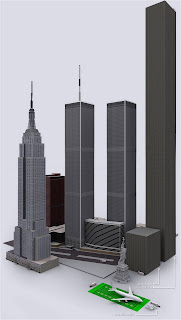 This is the total US unfunded liabilities. To the right you can see the pillar of cold hard $100 bills that dwarfs the WTC & Empire State Building - both at one point world's tallest buildings. If you look carefully you can see the Statue of Liberty.
The 114.5 Trillion dollar super-skyscraper is the amount of money the U.S. Government knows it does not have to fully fund the Medicare, Medicare Prescription Drug Programme, Social Security, Military and civil servant pensions. It is the money USA knows it will not have to pay all its bills.
The unfunded liability is calculated on current tax and funding inputs, and future demographic shifts in US Population.
With the market cratering around the world today it should be enough of an alert that you should be in cash or gold. Once again to protect your wealth for the next few years look to http://www.fixedratedeposits.com/ as a source of excellent rates on your short term cash investments.
Now I normally do not use other people's work or images to make my point but these are so powerful that I thought you would enjoy seeing them. Below each is a brief commentary. The point of the matter is that until this mountain of debt starts to shrink there is trouble ahead. Combine this with the massive load of sovereign debt in Europe and other parts of the world and you can understand why the chances of a global soft landing are minimal. Remember that these debt levels continue to rise each and every day. You can learn more about how and why this happened by reading Ellen Brown's "THE WEB OF DEBT".
One Hundred Dollars - $100

Ten Thousand Dollars - $10,000

Enough for a great vacation or to buy a used car. Approximately one year of work for the average human on earth.
One Million Dollars - $1,000,000

Not as big of a pile as you thought, huh? Still this is 92 years of work for the average human on earth.

One Billion Dollars $1,000,000,000

You will need some help when robbing the bank. Now we are getting serious!
One Trillion Dollars - $1,000,000,000,000

When the U.S government speaks about a 1.7 trillion deficit - this is the volumes of cash the U.S. Government borrowed in 2010 to run itself. Keep in mind it is double stacked pallets of $100 million dollars each, full of $100 dollar bills. You are going to need a lot of trucks to freight this around.
If you spent $1 million a day since Jesus was born, you would have not spent $1 trillion by now...but ~$700 billion - same amount the banks got during bailout.

15 Trillion Dollars - 15,000,000,000,000

114.5 Trillion Dollars - 114,500,000,000,000

The 114.5 Trillion dollar super-skyscraper is the amount of money the U.S. Government knows it does not have to fully fund the Medicare, Medicare Prescription Drug Programme, Social Security, Military and civil servant pensions. It is the money USA knows it will not have to pay all its bills.
If you live in USA this is also your personal credit card bill; you are responsible along with everyone else to pay this back. The citizens of USA created the U.S. Government to serve them, this is what the U.S. Government has done while serving The People.
The unfunded liability is calculated on current tax and funding inputs, and future demographic shifts in US Population.
Note: On the above 114.5T image the size of the base of the money pile is half a trillion, not 1T as on 15T image. The height is double. This was done to reflect the base of Empire State and WTC more closely.
Source: Federal Reserve & www.USdebtclock.org - visit it to see the debt in real time and get a better grasp of this amazing number.
Subscribe to:
Posts (Atom)